
Coppicing
Coppicing is a traditional method of woodland management which takes advantage of the capacity of many species of trees to put out new shoots from their stump or roots if cut down. You can coppice most species of tree but in the South of England, coppicing was traditionally used on Hazel, Hornbeam, Field Maple, Ash, Sweet Chestnut, Small-Leafed Lime and rarely, Oak or Beech.
An example of previously coppiced Hazel in Dormouse Wood
Coppiced hardwoods were used extensively in carriage and shipbuilding and they are still sometimes grown for making wooden buildings and furniture. Coppicing provided wood for many purposes, especially charcoal, before coal was economically significant.
A few woods are still operated for coppice today, producing material for hurdle-making, thatching spars, charcoal-burning and a range of crafts, including basket weaving. In Dormouse Wood we have started using Hazel to weave small items such as the bases for decorative wreaths and Hazel poles of many sizes are available to purchase on this website in the Shop.
We are also planning to coppice or pollard much of our Willow, as the wet ground causes these trees to grow too quickly and then collapse or fall because their internal fibres are weak.
In a coppiced wood, which is called a copse, young tree stems are repeatedly cut down to near ground level, resulting in a stool. New growth emerges and after a number of years, the coppiced tree is harvested and the cycle begins again. It is vital to protect newly coppiced trees from grazing by deer.
Pollarding is a similar process to coppicing but carried out at a higher level on the tree.
The historic practice of coppicing as a landscape scale industry is something that remains of special importance in southern England.
Typically a coppiced woodland is harvested in sections or coups on a rotation. This delivers an annual crop.
Coppicing has the effect of providing a rich variety of habitats, as the woodland always has a range of different aged coppice growing in it, which is beneficial for biodiversity.
The rotation length depends on the species, the local custom and the use to which the product is to be put. Birch or Willow is often coppiced for on a three or four year cycle for small items such as pea sticks. Whereas Sweet Chestnut is generally coppiced at between 15 and 35 years to produce poles for fencing or larger planks.
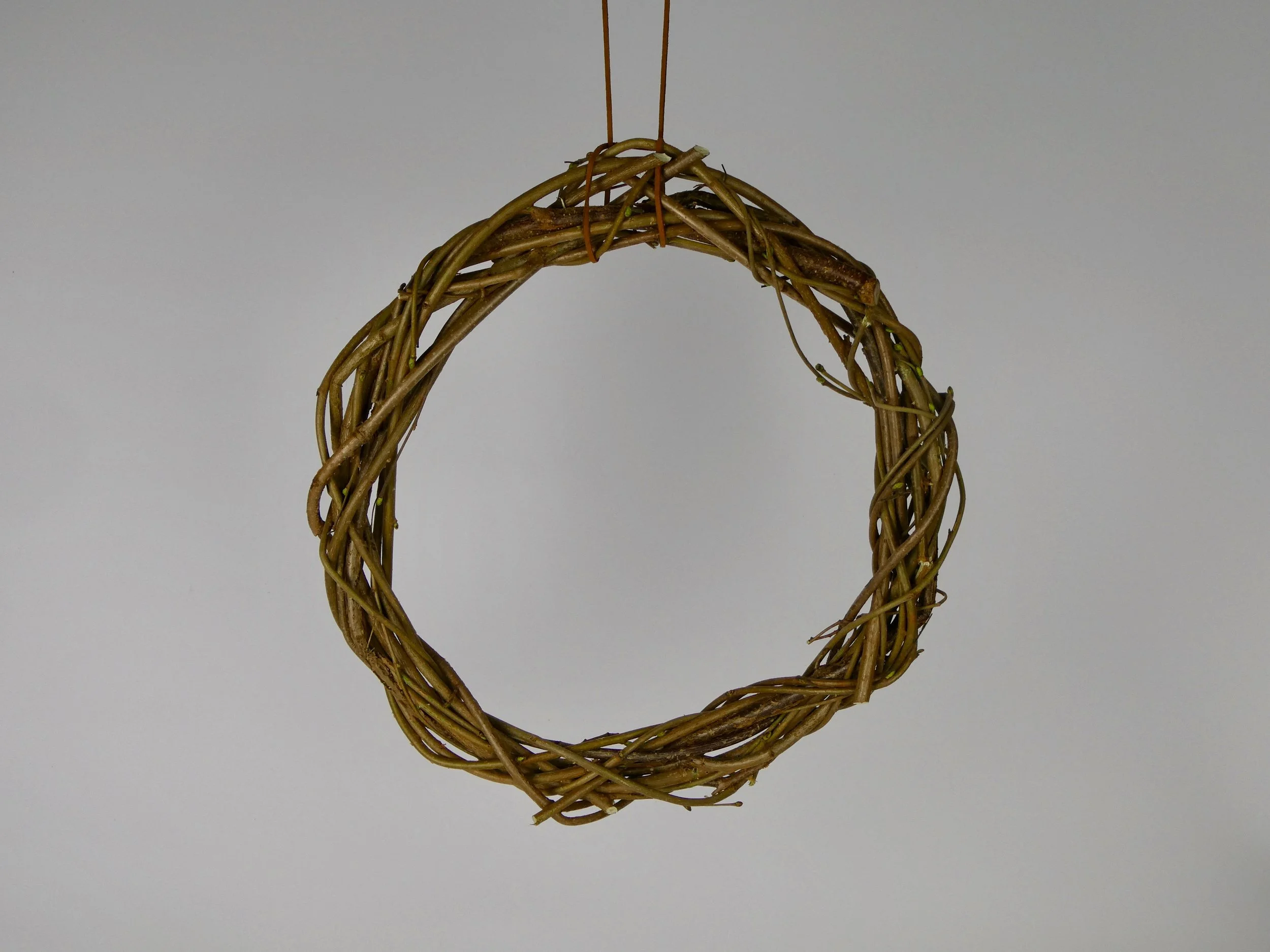
A wreath base woven from Dormouse Wood Hazel
Hazel, which is the main coppiced tree in Dormouse Wood will end up on a mixed rotation, varying between 10 - 15+ years. This is to ensure that enough trees keep producing hazelnuts for the Dormice. This would not happen if all the trees were coppiced early.
Coppicing keeps trees at a juvenile stage. A regularly coppiced tree will never die of old age. Some coppice stools may therefore reach immense ages. The age of a stool can be estimated from its diameter and some are so large—perhaps as much as 5.4 metres (18 ft) across—that they are thought to have been continually coppiced for centuries. This explains why Dormouse Wood has Hazel trees of unusual size and age - the coppicing process has kept them young and they have lived for many hundreds of years.
However coppicing has not been undertaken in Dormouse Wood for at least 30 years and it is important to start coppicing our Hazel trees again (to bring them back into rotation) as this will help to keep them alive and health for a few more hundred years.