
The True Meaning of Seasonality
One thing that Dormouse Wood is teaching me - and it’s teaching me a lot - is the true meaning of seasonality.
In my last post I mentioned I hadn't been able to get to the wood for three weeks because one of my dogs suffered a nasty paw injury (Leon is finally all healed and allowed to play ball again, he is SO happy!).
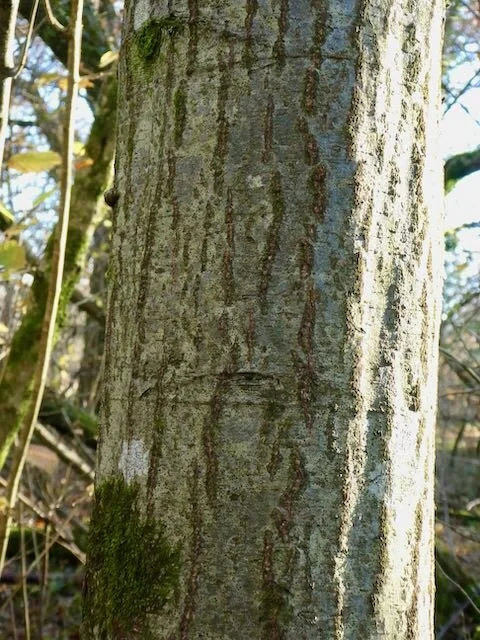
Alders have a distinctive bark pattern
However that really brought home to me the duel speed of life in a woodland. In many ways it’s an incredibly slow environment. A tree can take 30 - 50 or more years to reach maturity and potentially live for hundreds of years. At the other end of the cycle of life, it can take years for dead wood to fully break down. Yet, in smaller ways the wood moves at great speed. Miss a few weeks or even days and something you wanted to harvest is gone. This year I missed the best of the crab apples, plus that three week gap seems to have left me minus the alder cones I was hoping to collect.
The alder is a tree which tolerates wet conditions very well and around 40 years ago someone planted about a dozen at one end of the wood. I knew little about this tree until one of the foresters accompanying me on a visit pointed them out and gave me some insights. Apparently their bark can be used for dying, the inner bark gives yellow, the outer bark red. Historically it was also used an an anti-inflammatory and for smoking. One nugget of research told me that most of the pilings that form the foundation of Venice were made from alder trees.
Some alder species bear miniature woody cones, just 1/2 - 1 cm long. The trees have a distinctive pattern in their bark which has helped me to identify them even though their leaves have fallen. Having learned about alder cones I decided I would try and collect some, as they sounded perfect for adding to craft pieces. I had a look in early September and found just one tiny green cone on the ground. I was too early. I went back a couple of times without success and then came that three week gap. A week after returning to the wood I belatedly remembered the Alder cones and headed off to search. The ground was thickly covered in leaves and the branches bare. I spent almost half an hour walking around every tree, carefully scanning the ground and turning over the leaves, with almost no success - just a scant handful of cones and one nice sprig. I was too late. I must now wait an entire year for my next opportunity.
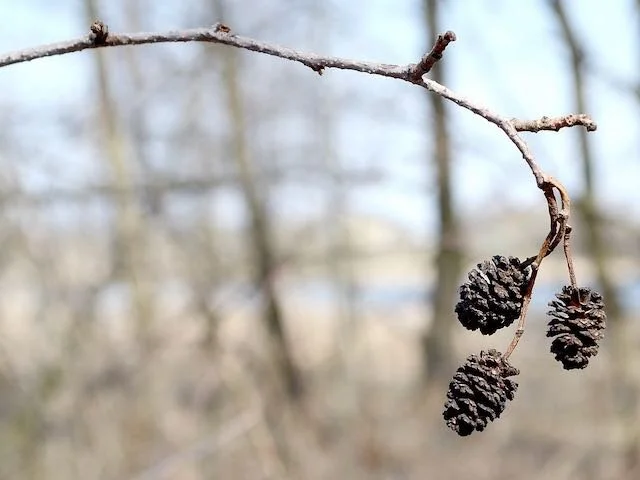
Tiny alder cones
If I add up all the times over the last two years when I wanted to collect something and failed because I was just that touch too late - last year I was away working at blackberry picking time - I am left with a lot of missed opportunities. From now on I need to be more precise and also learn more about everything I hope to harvest.
This experience also made me think about all those people, going back for hundreds of years who had to plan with such incredible care, to ensure they could successfully harvest everything they needed to live and to prosper. Today, so many of us have the incredible luxury of getting what we want, whenever we want it. This insight is hardly unique. But for me, the need to work in harmony with the rhythms of nature and the turning of the seasons if I am going to gather what I want, is new and is definitely a learning experience.
If I was scored on ‘Seasonality Awareness’ to date, I would definitely not get top marks and would probably deserve a comment such as “Must try harder”.
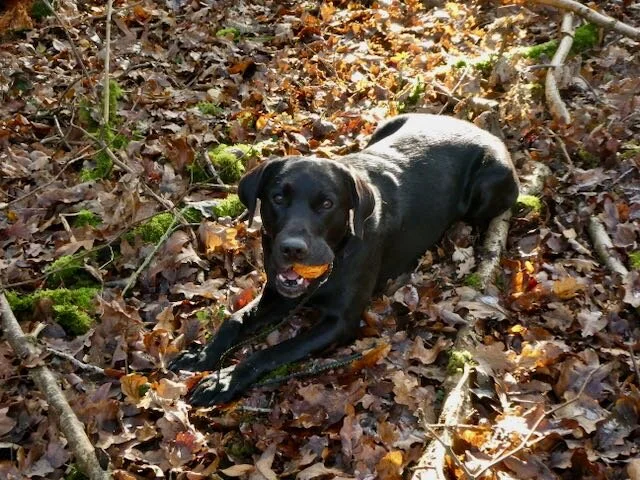
Happy Leon, finally reunited with his ball on a rope