
It’s My Woodland and I’ll Cry if I Want To
The Tragedy of Ash Die Back Disease
I haven’t actually cried over the Ash Die Back in Dormouse Wood but it has been close at times. There have certainly been sleepless nights.
When I bought Dormouse Wood I knew it was infected with Ash Die Back, a dreadful tree disease which, like Dutch Elm Disease before it, seems to be trying to kill off an entire species.
I knew but didn’t appreciate the likely impact. However, even two years ago it wasn’t clear that the disease would move so fast - it was thought to be slow. So, in the last year I have done a massive amount of research to find out more and create the best possible management approach for our beloved Dormouse Wood.
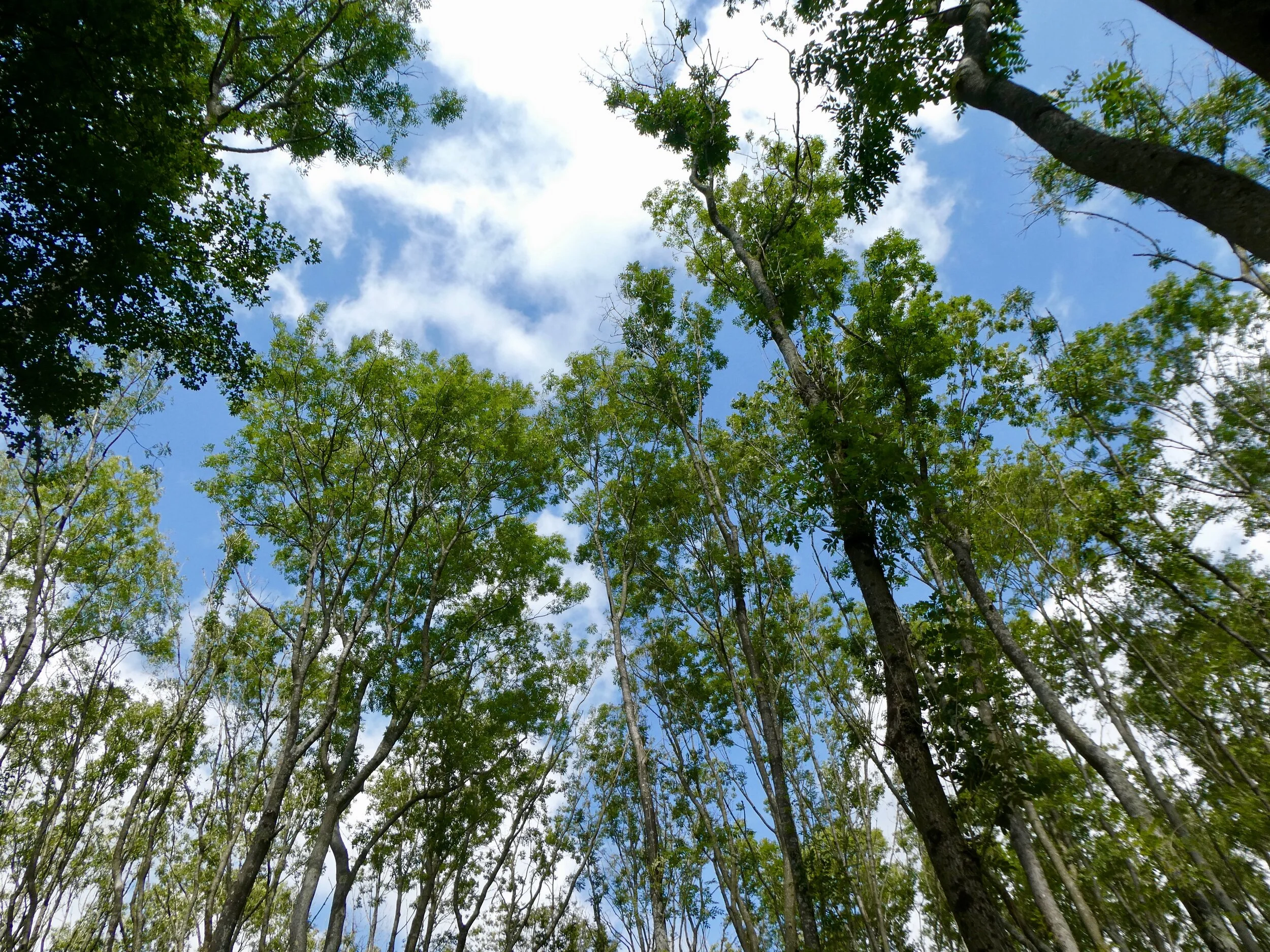
Most of this Ash seems healthy but look at the branch tips of the tree to the right
Before I share my plan to deal with this disease should probably explain a bit about Ash Die Back:
What is Ash Die Back?
Ash dieback (Hymenoscyphus fraxineus) is a fungus which originated in Asia. It doesn’t cause much damage to its native hosts, the Manchurian and Chinese ash. However, its introduction to Europe about 30 years ago began the ongoing devastation of the European ash (Fraxinus excelsior). This is because our native ash species did not evolve with the fungus and has no natural defence against it.
Ash Die Back was first recorded in the UK in 2012, in the South-East and is now present across the country. If you see an ash, no matter how healthy it looks, it is still almost certainly infected.
The fungus overwinters in leaf litter on the ground, particularly on ash leaf stalks. Between July and October it produces small white fruiting bodies which release spores into the surrounding atmosphere. These can blow for miles, spreading the disease. The spores land on leaves and stick to them, before beginning to penetrate into green growth and gradually the rest of the tree. The fungus keeps growing inside the tree, eventually blocking its water transport systems, causing it to die. That is if another fungus doesn’t attack the weakened tree and kill it first.
Trees can and do fight back. Certainly older ash generally do better at resisting, often for years. Sadly though, it seems that, in most cases, the tree will eventually die.
The Symptoms
Ash trees are very tall, making it hard to see some of the earlier symptoms, since they start at the crown. It is also more difficult to spot in winter, without the telltale leaf problems, but here is a summary:
Leaves develop dark patches before wilting and discolouring to black. Leaves might shed early.
Shoots die back and loss of leaves is visible in the summer.
Lesions can develop where branches meet the trunk. These are often diamond-shaped and dark brown.
The inner bark looks brownish-grey under the lesions.
New growth often comes from previously dormant buds further down the trunk. This is called epicormic growth and is a common response to stress in trees.
The Likely Impact
It is estimated that we will lose around 95% of the UK’s ash trees in the next few years. That will cause a massive alteration in the UK’s landscape and alter its ecology, as the plants, animals and insects which have a link to the species (for example using it as food) will also be impacted.
Having said that, no one is actually certain of the final outcome, or of the speed at which the disease will progress. Additionally, we may find that our native species also develop a resistance. We simply can’t be sure until time passes.
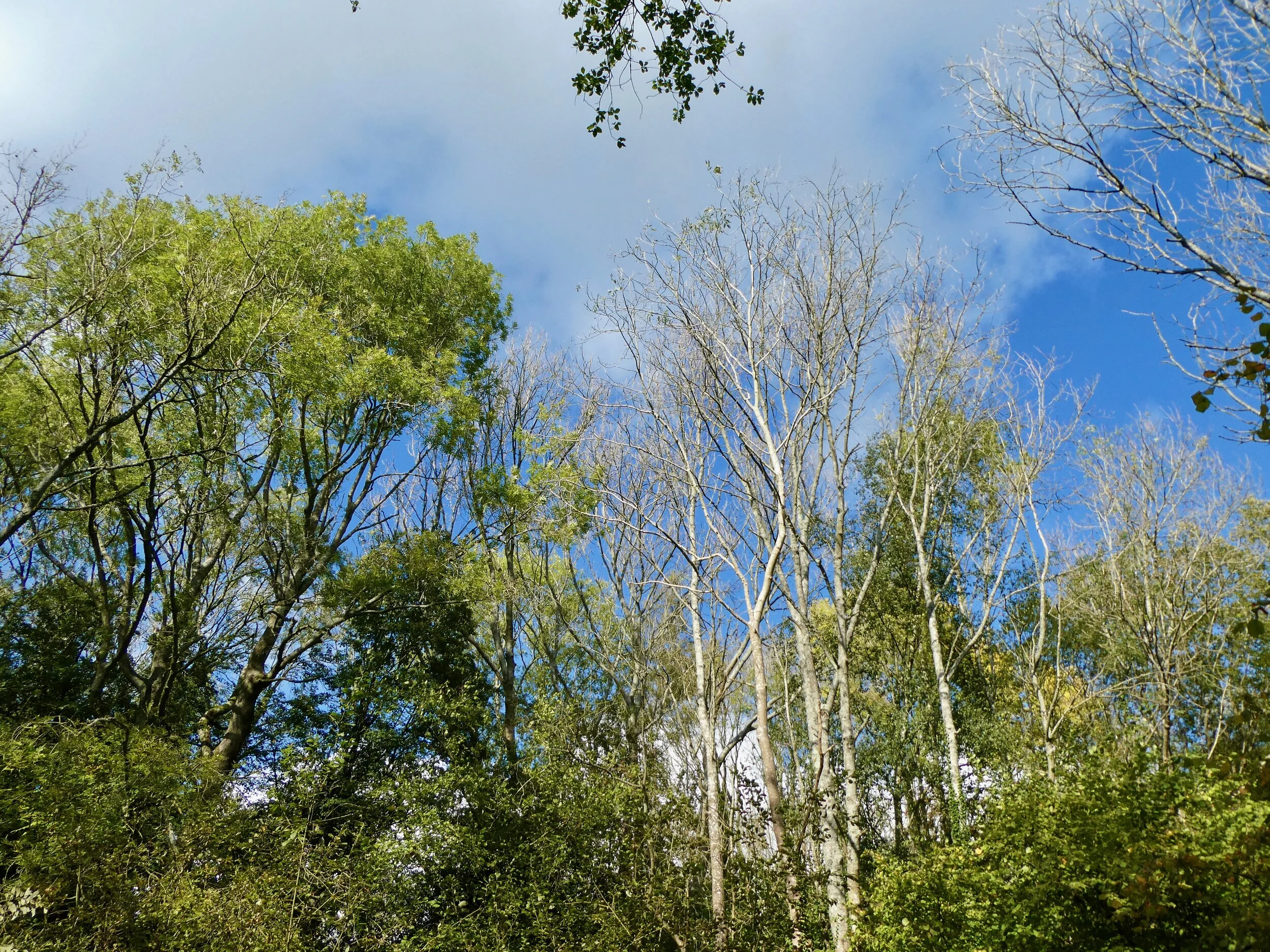
Most of the Ash is 40 - 50 years old so should have greater resilience than young trees
What about Dormouse Wood?
The majority of the high canopy in Dormouse Wood is composed of ash. There are other species, including oak and hornbeam but if you walk around and keep looking up you will see that at the highest level of the wood, tree after tree is ash. Looking upwards and trying to assess the scale of the problem is exactly what I have been doing this year, along with every person with any expertise in the subject who I could persuade to visit and give an opinion.
For a while it left me feeling very low. I love Dormouse Wood deeply and imagining all these lovely trees dying and having to be felled is desperately upsetting.
I realise in retrospect that the first part of the year was spent trying to get an answer other than the one I was repeatedly given. That answer, came down to: “the disease is here and if you ignore it then in a few years you will have a wood full of dead and dangerous trees which will spread secondary infections to other trees”. In essence - “if you want to kill Dormouse Wood then all you need to do is put your head in the sand and wait.”
That is obviously the last thing I want and the disease isn’t going away just because it upsets me. So I faced up to reality and started looking for the best possible active management solution, given the uncertain speed and final outcome of Ash Die Back. I started by getting two experienced Foresters to create a formal Woodland Management Plan. This document has been reviewed and recently approved by the Forestry Commission. It comes with a ten year felling licence, which sadly I will be needing.
What is the Strategy?
After listening to the advice and reading extensively I made the decision to plan for a worse case scenario - in which the majority of the ash would have to be felled within the next two to three years. This would automatically provide the thinning that some of the wood needed anyway and where unwanted gaps were created we would re-plant with a mix of other native species including oak, hornbeam, wild service, wild pear and lime. This fast paced intervention would result in a woodland which would take quite a few years to recover its full beauty but with the young trees properly cared for, it should have a healthy and secure future.
Worst case option sorted out and approved by the Forestry Commission, I now had to decide what I would aim to do, if the disease doesn’t force me into more drastic measures.
Every commercial forester I spoke to recommended using one of the companies that bring in heavy machinery to fell the trees, rather than felling with chainsaws. The argument was that the machinery made the work quicker, easier and cheaper. They strongly advised I have all the ash removed in just one or two years, to make the scale of work viable and to get rid of the disease problem quickly. The company I chose would then move the timber off site and buy it. This is called selling ‘standing timber’.
Another option was to engage my own team to fell and then sell the timber “roadside” (i.e. the buyer’s lorries come and take it away after it has been felled and piled in a stacking area with road access for the timber lorries). However this just didn’t work financially I would be left with all the organisation, responsibility and expense but still get a fairly low price for the timber.
Having heard the “sell your standing timber” proposal from several sources I remained unhappy with many aspects.
Firstly, the foresters doing the felling would be paid on a piecework basis, encouraging them to work at maximum speed rather than being careful not to damage the woodland. That doesn’t suggest they wouldn’t try to be careful, or be poor at their jobs in any way, simply that their priority would be speed.
Secondly, the machinery and falling trees would cause a great deal of damage to both the woodland floor and to other trees and plants. A large operation would also be very disruptive to wildlife. Damage and disruption are inevitable in felling of any scale but I want to minimise it. I also want control over what is felled and how, with the ability to adjust my decisions as work progresses - not an option with a larger scale contractor.
Thirdly, I would have to pay to create a stacking and turning area for a large timber lorry, as well as doubling the size of the entrance (think removing several large trees, installing a bigger gate and building a much stronger, wider bridge over a ditch). I would also have to persuade my neighbours, who would be very unhappy about all the large lorries and disruption, to let me cut back the trees along and above the very narrow track leading to the woodland’s gate. Plus pay to make good the inevitable damage to that track.
Finally, profit on the standing timber would equate to only a few pounds per tree.
In summary, after the expensive preparation work and the need to bring in professionals to ‘tidy up’ after the felling (a massive task) I would actually be paying to have the trees felled and taken away. There would be no profit at all to re-plant or to care for Dormouse Wood going forward. I know many landowners do take this route and I can understand why - it’s easy, plus people with a lot of land can often live with letting the damage to their woods repair itself over a few years, instead of paying for it to be mitigated by human intervention. I soon realised though that I couldn’t bring myself to go down this route. I needed an alternative.
Having been repeatedly told what any sensible person would do in my circumstances, I spent several months trying to come up with an approach that would minimise damage to the wood, give me precise control over what trees were felled and when, avoid the site access issues and also make a profit to help care for Dormouse Wood and restore it in the wake of the Ash Die Back.
In the end, with the help of my Forester, Rob, who does all the skilled work in Dormouse Wood, I found a solution ….
… start my own timber business and manage the entire process, doing everything onsite, including processing and selling the timber. With the expert support coming from Rob.
None of the commercial foresters I tried this idea on actually laughed but clearly most thought I was slightly mad, to go to this much trouble for a mere 21 acres. I however believe it is well worth it. It will also be a fantastic learning experience.
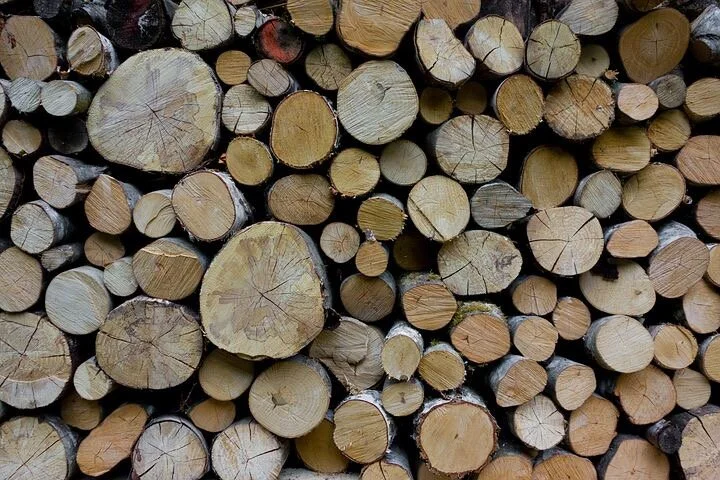
Demand for quality firewood is currently very strong, so hopefully our firewood will do well
That is where we stand. Rob and I are putting in place a detailed business plan (including much Health & Safety planning etc.) and starting to set up an operational infrastructure. Once that is ready, each winter we will assess the wood, agree which infected trees need to be felled - before they become dangerous and while the timber is still in good condition. Rob and a fellow sub-contactor will then take down the chosen trees, minimising damage even though it will take longer. After removing the branch ends (called brash) the wood will be cut into manageable sections and transported to an onsite processing area. There we will divide the timber into three classifications.
1. Potential larger timber for fine furniture making etc.
2. Decorative wood which will be perfect for this website.
3. Firewood. Ash is known as the King of Firewood, having a very low moisture content, so we should be able to get a good price once it is seasoned.
Finally, I will comb through the brash and harvest everything possible. From leaves for preserving, to attractive sticks and small branches, again for sale on this website. The remainder will be piled up as dead wood habitat, to enrich the woodland eco-system.
The aim is: minimal damage, minimal disruption, minimal wastage and minimal timber milage. Plus, maximum control, maximum speed of recovery for the woodland, maximum income (and no angry neighbours).
This approach will take considerable commitment, time, effort and a rather frightening level of upfront investment. However having looked at it in detail, it seems the best way to manage the Ash Die Back and safeguard Dormouse Wood in both the short and long term.
I will let you know how we get on.